Ergothioneine: The Compound That Changed How We Think About Mushrooms
Coming Soon -
I’m excited to announce the upcoming release of my new book on Ergothioneine.
This has been an ambitious and rewarding project, bringing together the rapidly growing research on ERGO with my own interpretation of its role in human evolutionary biology, physiology, health and clinical practice.
The book is written for practitioners, clinicians, researchers, citizen scientists and mushroom enthusiasts wanting a deeper dive into why ergothioneine may be far more important to human biology than we have previously recognized.
If you’d like to be among the first to hear when the book is released, enter your details below.
Receive publication updates, release news and early access information.
Join the Ergothioneine Book List
What is Ergothioneine?
There are moments in science when a compound sits quietly in the literature for decades — known, catalogued, chemically described, yet largely overlooked — before the research community fully grasps its biological relevance and therapeutic potential. Ergothioneine is one of those compounds.
First isolated in 1909 from ergot fungus, ergothioneine (you’ll see it written as ET, EGT, or ERG across the research; I prefer ERGO) is a sulphur-containing amino acid derivative found almost exclusively in fungi. For much of the twentieth century, it attracted only passing interest. It wasn’t until the discovery of the dedicated human transport system in 2005 that the scientific world began to sit up and pay attention.
What makes ergothioneine genuinely unusual is this: unlike the vast majority of dietary compounds we consume, the human body goes to remarkable lengths to hold onto it. It is actively absorbed, selectively distributed to tissues under the highest oxidative and metabolic stress, and aggressively conserved by the kidneys rather than excreted. Its half-life in the human body is approximately one month — extraordinarily long for a water soluble dietary compound of this kind. From an evolutionary perspective, biology rarely conserves a molecule so tightly without good reason.
A Body Designed to Hold Onto It
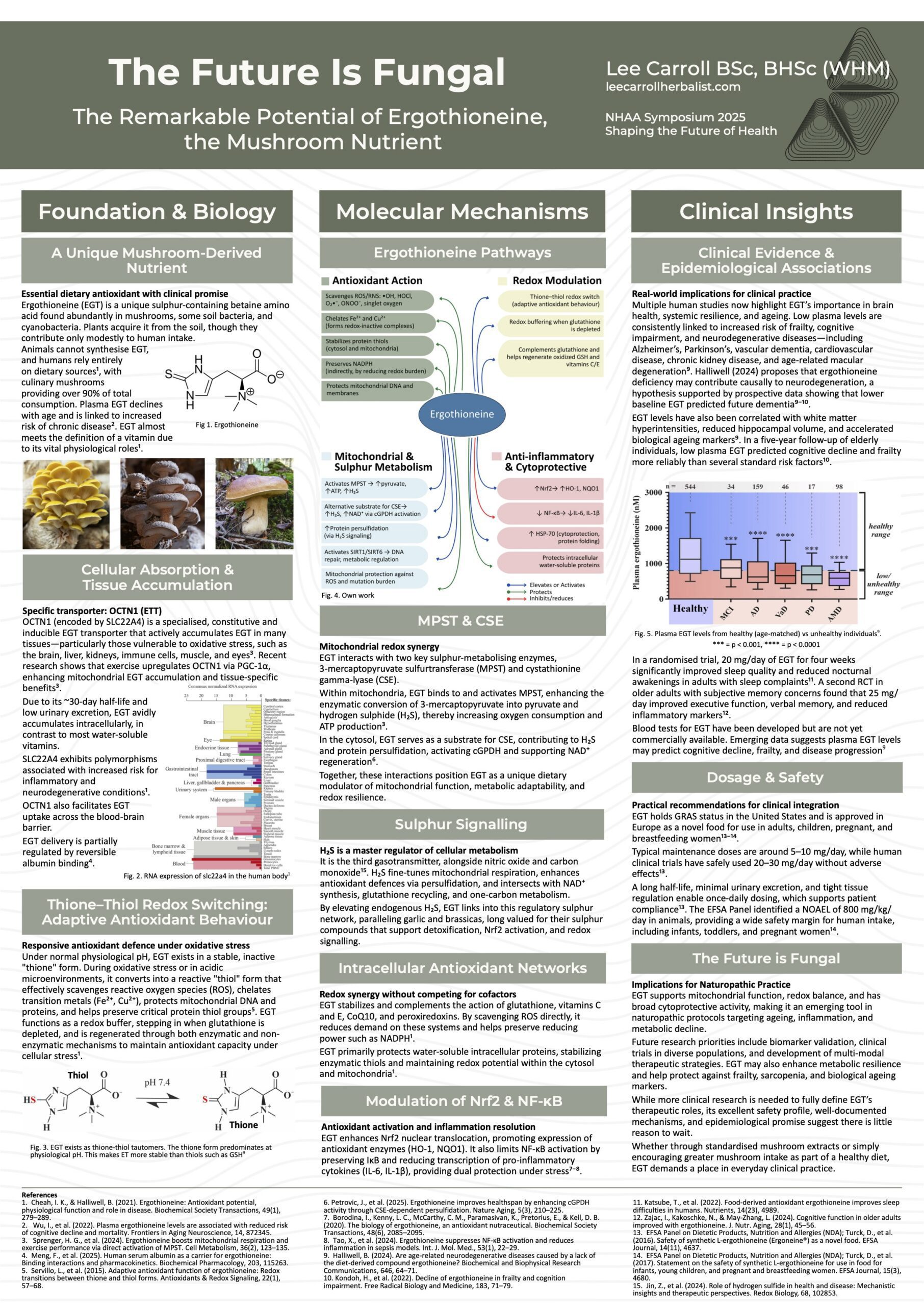
Fascinatingly, humans possess a dedicated transporter — encoded by the gene SLC22A4, also called the Ergothioneine Transporter, or ETT (previously OCTN1) — whose primary, possibly sole, biological purpose appears to be the uptake and accumulation of ergothioneine. This transporter is found across virtually all tissues, is conserved across vertebrates through hundreds of millions of years of evolution, and accumulates ERGO preferentially in the places that need it most, including red blood cells, the liver, the brain, eyes, immune cells, skeletal muscle, and bone marrow.
The existence of this system is, in itself, a compelling argument. Evolution does not maintain dedicated molecular machinery for compounds that don’t matter. As the biochemist Bruce Ames and colleagues have argued, ergothioneine may belong to a class of nutrients he terms “longevity vitamins” — compounds that don’t produce acute deficiency diseases when absent, but whose long-term insufficiency quietly accelerates biological ageing and increases susceptibility to chronic disease.
The question of whether ergothioneine constitutes an essential micronutrient — something closer in status to a vitamin than a general dietary antioxidant — is an actively debated question in contemporary nutritional biochemistry. We don’t yet have a settled answer. What we do have is a rapidly growing body of evidence that makes the question increasingly difficult to set aside.
From Fungi to Cells — How EGT Reaches Every Tissue
Humans and other animals cannot synthesise ergothioneine. Plants can absorb it from the soil via mycorrhizal fungal networks, but accumulate only negligible amounts. The compound is biosynthesised almost entirely by fungi — including the mushrooms we eat — and by certain soil bacteria. What reaches our tissues arrives through diet, which, in practice, means fungi are our primary and most reliable source.
This creates an intriguing lens through which to re-examine the traditional role of medicinal and culinary fungi in human health. Mushrooms such as oyster, shiitake, and porcini contain meaningful concentrations of ERGO. When we consume them, the compound is absorbed through the intestinal wall via the ETT transporter, passes into circulation, and is distributed to tissues — where it continues to accumulate with regular intake over weeks to months.
Once inside cells, ERGO is not simply a reactive scavenger. It operates with a degree of biological intelligence that sets it apart from conventional dietary antioxidants — selective in what it targets, active across multiple cellular compartments, and integrated with the cell’s own protective systems rather than working in isolation. The emerging picture is more dynamic still — and for those tracking longevity science, more significant than it might first appear. ERGO engages a chain of enzymatic reactions, centred on a process called persulfidation, that is central to cellular energy, resilience, and longevity signalling. We are looking at a compound that does not simply neutralise damage, but appears to sit at the centre of a biological signalling network whose implications for human health are still unfolding.
What the Research is Telling Us
The evidence base for ergothioneine has accelerated substantially in the last decade, and the coherence of the research to date is remarkable.
Population studies — including a significant 11-year cohort study of over 1,300 individuals in Japan — have found that people with higher circulating levels of ergothioneine show markedly lower rates of dementia, with those in the highest quartile demonstrating roughly a 46% reduction in risk compared to the lowest. Separate human cohort data link lower ERGO levels to increased cardiovascular mortality, frailty, and accelerated cognitive decline. Plasma ergothioneine declines with age in healthy adults — and declines faster in individuals who go on to develop dementia.
Preclinical research has extended this picture considerably. Models of neurodegeneration, liver injury, kidney damage, cardiovascular stress, and inflammatory disease consistently show protective effects associated with ERGO. Its mechanisms of action include direct neutralisation of reactive oxygen species, modulation of the master antioxidant transcription factor Nrf2, suppression of pro-inflammatory signalling, and — most intriguingly — activation of cellular pathways that enhance mitochondrial function and sirtuin-mediated longevity programmes.
There is also emerging clinical evidence for skin health, reproductive function, exercise performance, cognition and sleep, and protection against medication-induced organ toxicity. The breadth of biology ERGO touches is unusual for a single compound — and it is precisely that breadth, combined with the molecular logic of the dedicated transporter, that has drawn serious research attention from groups across Europe, North America, Japan, and Australia.
However, more human research is still required. Many of the most compelling findings remain preclinical. The optimal intake for human health has not been definitively established. The question of whether ERGO supplementation benefits individuals with already-adequate levels remains open. And the relationship between whole-mushroom consumption and isolated ERGO — with all the synergistic compounds a real food brings — is not yet fully mapped. These are not reasons for scepticism so much as the normal texture of a maturing field.
My Research: Bridging Clinical Practice and Emerging Science
My interest in ergothioneine began in the literature. In 2020, while deep in the research building educational material on medicinal mushrooms for practitioners and industry, I was struck by how ERGO appeared to be a molecule of extraordinary biological significance, and yet almost no one was talking about it. The more I connected the evidence, the more coherent the picture became. Those early hunches have since been steadily validated.
That understanding, and the growing body of evidence behind it, now informs a broader research focus. My work sits at the intersection of mycotherapy, nutritional biochemistry, and clinical herbal medicine — and alongside a small research team, we are asking questions that are often left unaddressed when ERGO is studied purely in isolation: Where might ERGO make the greatest difference — and for which patients, at which moments in their health journey?
And beyond mushrooms — how does ERGO interact with the broader matrix of herbal medicine? The synergies that might exist across a wider therapeutic tradition are largely unexplored, and that territory is worth mapping.
These questions sit at a productive edge between bench science and clinical practice — and they are ones that practitioners, not just researchers, are well-positioned to ask.
Why Mushrooms Matter More Than We Thought
Taken together, the ergothioneine story represents something of a paradigm shift in how we understand the health value of fungi. For decades, the primary bioactive compounds in medicinal mushrooms were understood to be the polysaccharides — beta-glucans as a prominent focus — with their well-documented effects on immune modulation.
Beta-glucans are biologically significant — their role in immune modulation is well established and clinically meaningful. But the body’s relationship with ERGO is categorically different: a dedicated transporter exists apparently for the sole purpose of acquiring it, and the kidneys actively conserve it rather than allowing it to be excreted. That level of biological commitment suggests essentiality — and may make ERGO the most important molecule that mushrooms deliver. Its reach is not immune-specific but systemic — touching cardiovascular health, neurological resilience, metabolic function, and potentially the rate of biological ageing itself.
And because mushrooms are essentially the only meaningful dietary source for most people in the modern world, the conversation about whether we are eating enough of them — and whether modern dietary patterns have quietly created a population-level insufficiency — becomes considerably more urgent.
This is not a question with a settled answer yet. But it is a question worth asking seriously. And it is the question that sits at the heart of my ongoing work.
I have written more extensively about ergothioneine in our research blogs and white papers — exploring the biochemistry in depth, reviewing the clinical evidence, and examining what the science may mean for clinical practice. You’ll find those linked throughout and below.